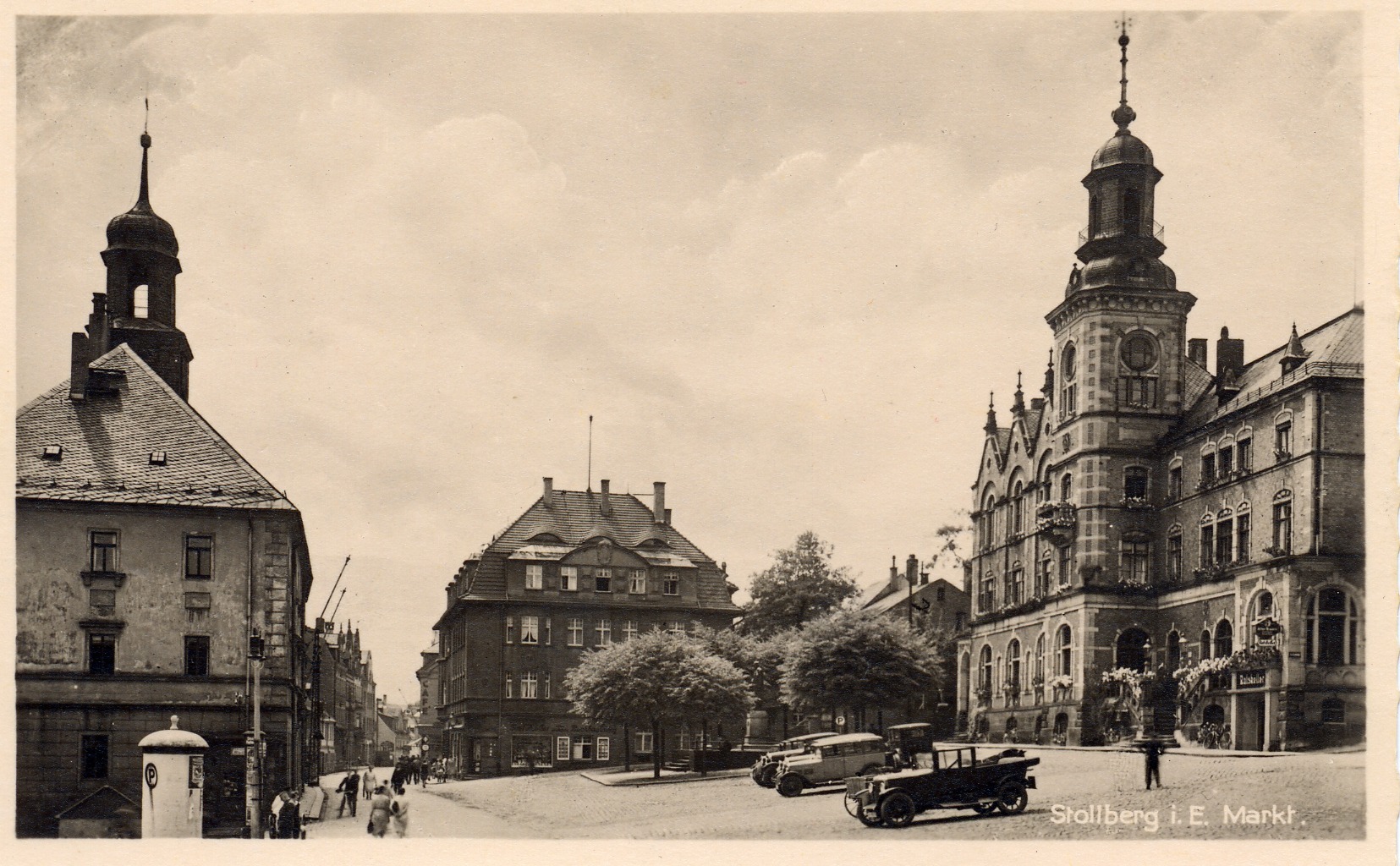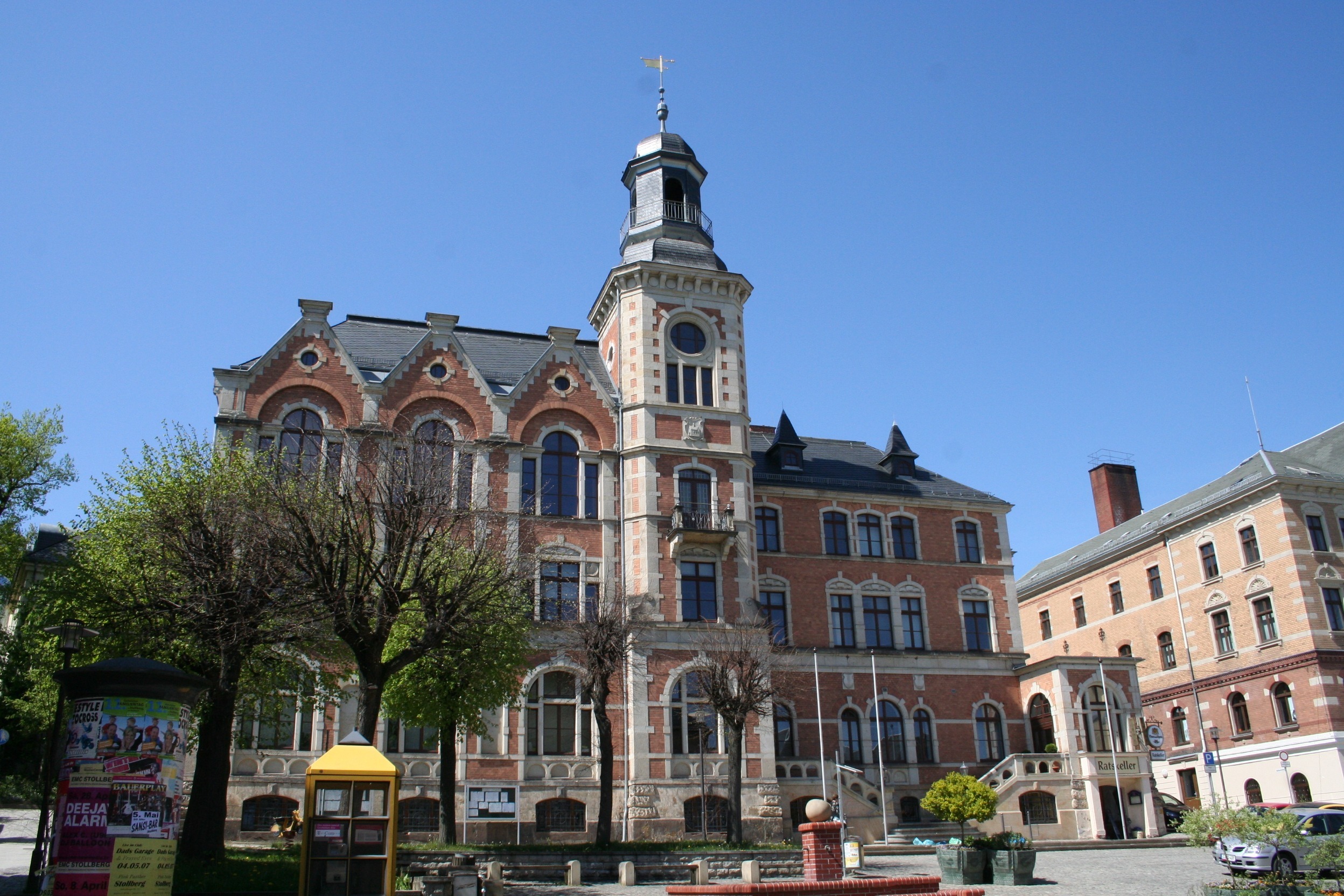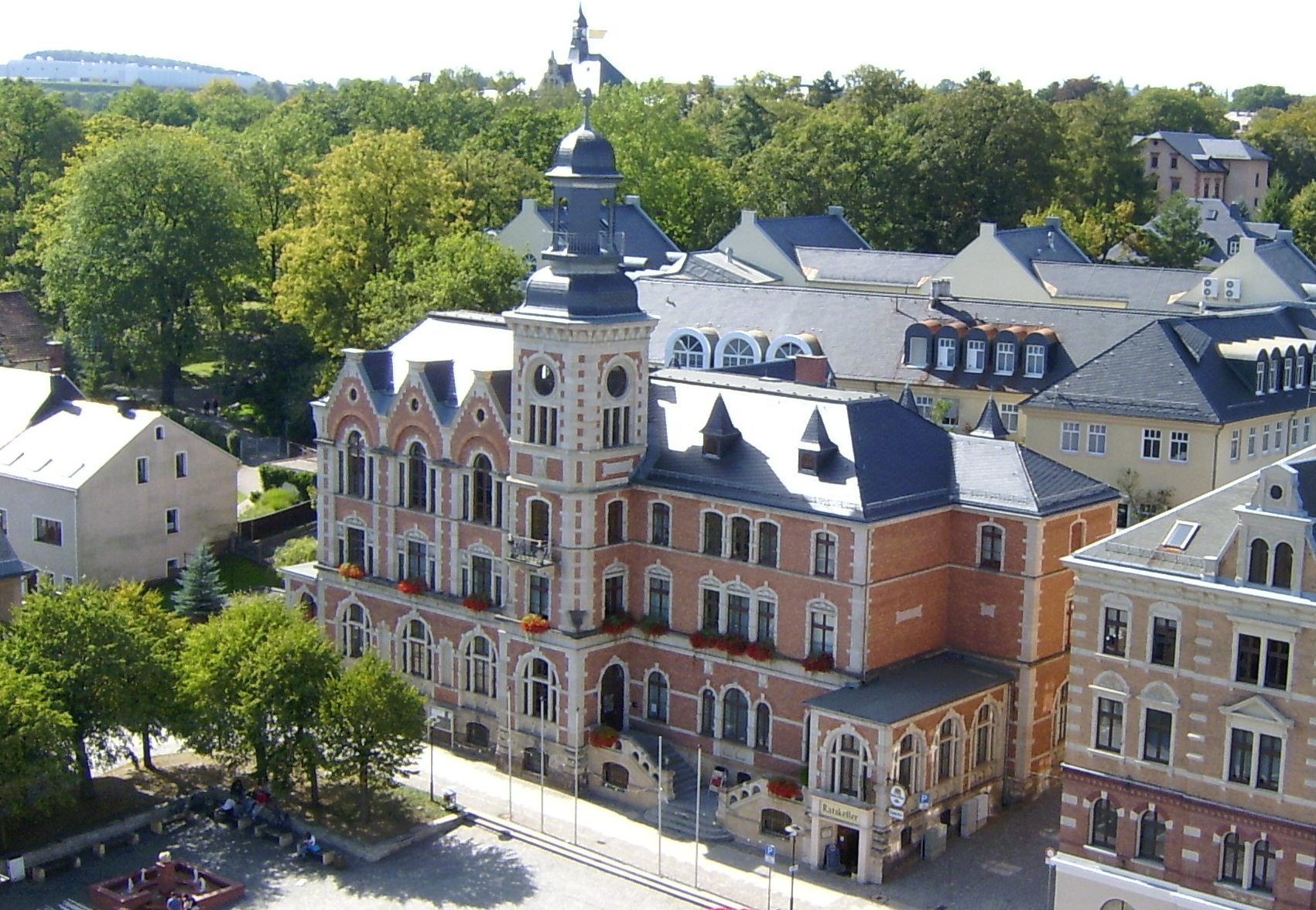
The Stollberg town hall (brick building with sandstone decorations)
In 1563, the first documented town hall, which stood on the site of today's district court, burned down. Rebuilt in 1599, it was reduced to rubble in 1633 during the great plundering. It was rebuilt in 1729 and destroyed again in the great fire of Stollberg in 1809. The foundation stone for the new town hall was laid on 09.05.1812. The master bricklayer Johann Traugott Winkler from Venusberg was commissioned by Mayor Kretzschmar to draw up the plans and cost estimate. The bricklayer and a master carpenter Roscher received the contract for the shell construction work. The town hall was to have a tower, clock and bell.
This new building served its purpose for around 50 years until the lower office requested rooms. The council ceded the former town hall. In the meantime, the Schmidtsche Haus (Tränkner) was rented for council purposes. Shortly afterwards, the council purchased the Prussian manor house on the market square and used it for town hall purposes and the council cellar. From 01.10.1855, the oldest savings bank was located in the town hall. In 1856, the old town hall was finally handed over to the municipal court.
In 1858, the newly acquired town hall was given a ridge turret with a bell, a prison, guard room and various extensions still had to be made so that the building could serve its purpose to some extent.
In 1886, the building was demolished and a new one was built in its place according to the award-winning plans of the architects Hertel and Neckelmann, Leipzig, under the supervision of the building council Gottschalk, who worked at the technical colleges in Chemnitz. This was carried out in 1886/87 by the master builder Karl Uhlmann.
The new town hall had a cellar on the first floor, the town planning office, the postal administration and the janitor's apartment. The savings bank, administration rooms and archives were on the upper floor. On the second floor, the town council meeting room and the mayor's apartment as well as other ancillary rooms.
The official opening ceremony took place on 19.10.1887. The keys were handed over to the mayor by master builder Uhlmann. The exterior of the town hall has not changed since then, but the interior has been altered several times and adapted to the respective requirements.
In 1920, permission was granted to install light bulbs. Gas was still supplied by Oelsnitz. Carpentry work was also carried out in the town hall in 1920, a vestibule door was installed as well as a partition wall between the savings and town treasury and a door for the town treasury counter. A table was specially made for the registry office. In this year, an oil painting by Georg Oehme entitled "Bachlandschaft" (worth 800.-M at the time) was also acquired, as well as a painting of the "Weißer Ross" (old inn on the market square) to liven up the dull walls. In 1922, a tower clock was purchased and in 1925 an application was made to separate the welfare office from the tax office due to the cramped space, risk of infection (infectious diseases, parasite infestation) and draughts, as well as hygiene requirements. In 1926, there were two official apartments on the second floor, which were remodeled and refurbished. The first floor was remodeled in 1935.