
Capital of Culture Chemnitz 2025
Capital of Culture Chemnitz 2025
Chemnitz Theaterplatz with (from left to right) Chemnitz Municipal Art Collections, Opera House of the Municipal Theatres, St. Petrikirche and Hotel Chemnitzer Hof (c) Nasser Hashemi

Welcome to Chemnitz - the European Capital of Culture 2025!
In 2025, Chemnitz, a traditional industrial city in Saxony, will share the title of "European Capital of Culture" with 38 municipalities from Central Saxony, the Ore Mountains and the Zwickau region. This region has an impressive cultural and industrial heritage.
Stollberg is also part of this special event!
For only the fourth time in 40 years, this prestigious title has been awarded to a German city by the European Commission. Chemnitz 2025 invites you to rediscover the cultural diversity of eastern Germany in the heart of Europe.
C the Unseen - Discover hidden treasures
"C the Unseen" - the leitmotif of Chemnitz 2025 is both an invitation and a concept. The aim is to bring the hidden to light and make the undiscovered visible. As European Capital of Culture, Chemnitz is focusing on people, places and activities that have received little tourist attention to date. In close cooperation with numerous local stakeholders, more than 100 projects in the fields of popular culture, music, art, sport and design are being created to bring the diversity and creativity of the region to life.
PURPLE PATH - An art and sculpture trail connects the region
With works by renowned international, national and Saxon artists, the PURPLE PATH art and sculpture trail will create an impressive open-air exhibition. This major project of the European Capital of Culture Chemnitz 2025 links Chemnitz with 38 surrounding cities and municipalities and brings art into the public space.
The sculptures and installations are located at significant sites and tell of people, crafts and industry. They invite visitors to rediscover the stories of the region. Under the leitmotif "Everything comes from the mountain", PURPLE PATH reflects the 850-year mining history of the region. The mining of silver, tin, cobalt, iron, kaolin and uranium has shaped the Ore Mountains, Central Saxony and the Zwickau region and shaped life for centuries. The Erzgebirge/Krušnohoří mining region has been a UNESCO World Heritage Site since 2019.
However, the region's cultural identity extends far beyond mining. A rich heritage also unfolds on the surface - from traditional arts and crafts to architecture and museums that bear witness to the heyday of industrialization. As part of Chemnitz 2025, nine maker hubs are also being created in the city and the entire Capital of Culture region. These creative workshops promote innovation, exchange and community - and invite everyone to get involved.
Purple Path (sculpture in Stollberg):
The sculpture "Bogen" - art as a bridge to history
Leunora Salihu's two-metre-high sculpture Bogen (Arch) rises up like a delicate, shiny silver piece of jewelry on the former dog run of the Hoheneck women's prison. The artist, who was born in 1977 in Pristina/Kosovo and now lives in Düsseldorf, has created a work made of hundreds of circular aluminum discs that is reminiscent of a tall, narrowly tapering gate.
The sculpture invites you to walk through it and observe the play of shadows that changes with the position of the sun, the weather and the seasons. Through the repetition and arrangement of modular pane elements, Salihu explores movement within a static form, the interplay of inside and outside and the invisible stories interwoven with place. Her clearly structured, constructive form is symbolically linked to Stollberg, whose old town is dominated by the mighty Hoheneck Castle.
Originally built as a hunting lodge, Hoheneck served as a remand prison from the 17th century and later as a penitentiary, the structure of which was massively fortified. After the GDR was founded in 1949, it became one of the country's most notorious women's prisons. Political prisoners were imprisoned there, and an application to leave the country was often enough to become a "Hohenecker". The prison conditions were inhumane: in the overcrowded prison - at times with up to 1600 women - isolation, dark detention and piecework were the order of the day. Under the most adverse conditions, the inmates produced tights and bed linen, which were sold to West German companies.
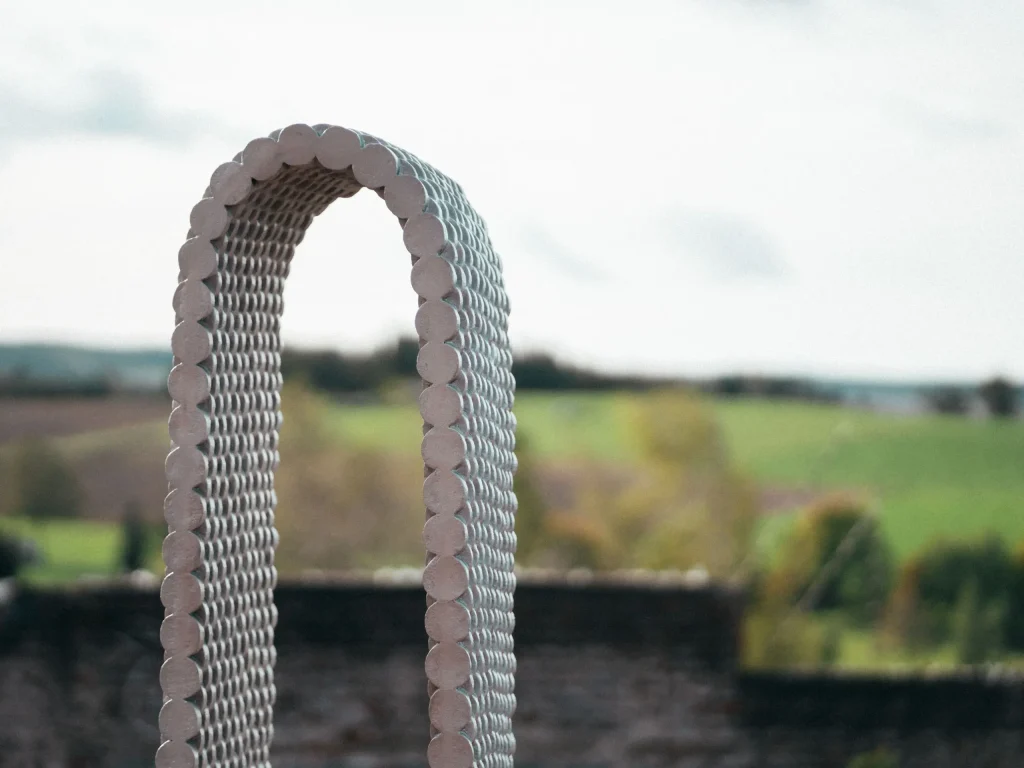
Photo: Ernesto Uhlmann
In this monotonous, oppressive reality, it was often only small signs that gave hope - such as the ray of sunlight that fell through the barred window arches into the dark cells. The Bogen sculpture recalls these moments and creates a link between past and present, between art and history.